

WRC
What it takes to move a WRC operation across continents
This year's FIA World Rally Championship includes the logistical challenge of having two rallies on one continent, with only a week separating the events.
One half of the South American double-header may have been successfully run and won, with Toyota’s Sébastien Ogier and Vincent Landais taking victory at the inaugural ueno Rally del Paraguay last weekend - but the work hasn’t stopped behind the scenes with Rally Chile Bio Bío set to begin next week and fast approaching.
So how does the WRC manage a double-header from a logistical point of view? Toyota Gazoo Racing has lifted the lid on how teams prepare for two long-haul events in three weeks.
A combination of air and sea freight was initially required for Toyota to transport all of its cars and equipment to last weekend’s round in Paraguay. This included nine sea containers that began their journey to Paraguay on 13 June, while 15 air freight containers transporting items including the rally cars took off on 14 August.

© Toyota Gazoo Racing
The sea freight containers include the team’s five recce cars, a kitchen, two workshops and one spare parts container. This process is all carried out by DHL, the team’s transport logistics partner.
Once the freight arrived in Paraguay and had been transported to the rally’s Encarnación service park, work began on creating Toyota’s temporary home from home and its operations headquarters for the rally.
A team of 10 personnel are required to build Toyota’s impressive temporary service park structures which includes tents to house its five GR Yaris Rally1 cars, its hospitality and buildings for its operations staff. It’s a process that takes three days to construct and takes only a day to dismantle.
Nineteen rally stages later and with the celebrations of Toyota’s record-equalling 102nd WRC win complete, work then begins to prepare to relocate and a prepare for Rally Chile Bio Bío.

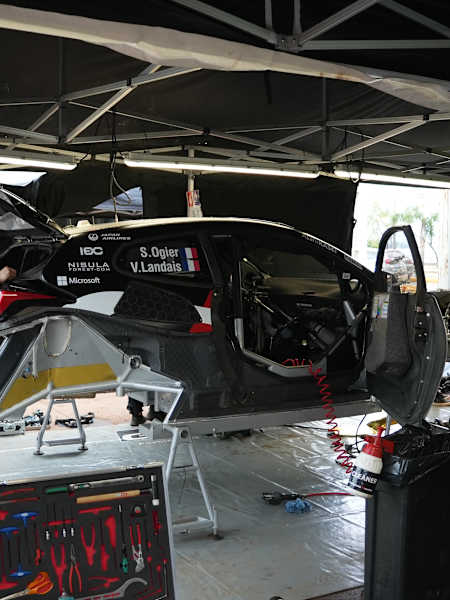
Sami Pajari's car undergoes re-preparation after Paraguay
© Toyota Gazoo Racing
Before the cars can compete in Chile, they will undergo a re-build and re-prep. This is undertaken in Paraguay and takes three days to complete the process across Toyota’s fleet of five GR Yaris Rally1 cars. This is undertaken by a workforce of 25 technicians, seven specialists, three engineers and four team coordinators.
The rebuild process is meticulous and intensive. On hand are 25 tool boxes, 12 jacks, spare body panels, transmissions and engines. Main body panels (nine) on each car can be changed. The engine is removed and reassembled along with the transmission.
Once this three-day herculean effort is completed, everything is packed up ahead of a 2,400km journey by road to Rally Chile Bio Bío’s host city Concepción. On arrival, Toyota’s home for home will be rebuilt ahead of 16 more stages, to complete the WRC’s South American double-header.


